
In Maritime Personal Injury Cases
NOT ALL LAW FIRMS ARE IN THE SAME BOAT
NOT ALL LAW FIRMS ARE IN THE SAME BOAT






Maritime law rewards people who save ships, cargo, and lives at sea, but only when they actually succeed. Here is how salvage claims work in U.S. admiralty courts, and how our firm applied those rules in the fight over the 1875 wreck of the SS Pacific.
Salvage is one of the oldest doctrines in maritime law. Its roots reach back through English admiralty courts to the sea codes of the Mediterranean, and its central idea has barely changed in centuries: a person who voluntarily rescues a vessel or its cargo from danger at sea is entitled to a reward paid out of the value of what was saved.
The rule exists for practical reasons. Ships in trouble far from shore depend on whoever happens to be nearby, and rescuing a burning, grounded, or sinking vessel is costly and dangerous. Without the promise of compensation, few would take the risk. Admiralty courts therefore treat salvage generously, describing it as a policy designed to encourage seafarers to come to the aid of property in peril rather than leave it to the sea.
A salvage award is different from ordinary payment for services. It is not measured only by hours worked or fuel burned. Courts deliberately set salvage awards above simple compensation so that the reward works as an incentive. At the same time, the salvor does not become the owner of the property it saves. The owner keeps title, and the salvor receives a maritime lien on the salved property that secures its right to be paid.
In the United States, salvage is governed by federal general maritime law developed by the courts, by the Salvage Act (46 U.S.C. §§ 80101–80107), and by the 1989 International Convention on Salvage, which the United States has ratified. Salvage disputes are heard in federal court sitting in admiralty, often as actions in rem brought against the vessel or cargo itself.
The Supreme Court summarized the requirements for a valid salvage claim in The Sabine, 101 U.S. 384 (1879), and courts still use that framework. A salvor must establish three things.
A marine peril
The vessel or property must have been in danger of loss or damage. The danger does not need to be immediate or absolute; it is enough that the property was exposed to a reasonably anticipated risk it could not escape without help. A ship aground on a falling tide, a disabled vessel drifting toward rocks, and cargo lying on the ocean floor have all been found to be in peril.
Voluntary service
The help must be given without a pre-existing legal duty to provide it. A vessel’s own crew, a tug already under contract to tow the vessel, and public agencies acting within their official duties generally cannot claim salvage for doing what they were already obliged to do.
Success, in whole or in part
The salvor’s efforts must actually contribute to saving the property. Effort alone is not enough. A salvor who works hard, spends heavily, and takes great risks but saves nothing is ordinarily entitled to nothing. This is the principle often summed up as “no cure, no pay.”
The success requirement is what separates salvage from an ordinary service contract. In the Ninth Circuit, which covers Washington and the rest of the West Coast, “success” means the preservation of the property for the benefit of its owner (Evanow v. M/V Neptune, 163 F.3d 1108 (9th Cir. 1998)), and a salvage award is available only where salvage is successful (Bartholomew v. Crowley Marine Services, Inc., 337 F.3d 1083 (9th Cir. 2003)). A salvor does not have to save everything, but it must show tangible success that is directly attributable to its own efforts. As the Supreme Court put it in The Sabine, proof of success, to some extent, is as essential as proof of service.
That requirement was the deciding issue in the SS Pacific case described below. Salvage is a reward for results, not for attempts.
Pure salvage, sometimes called merit salvage, arises when a salvor helps without any prior agreement with the owner. The salvor’s right to a reward comes from the law itself, and if the parties cannot agree on an amount, the court sets one.
Contract salvage arises when the owner and salvor agree on terms before or during the operation. Many commercial salvage jobs are performed under standard forms such as Lloyd’s Open Form, a “no cure, no pay” agreement that leaves the amount of the award to arbitration. Others use fixed-price or daily-rate contracts. Courts generally enforce salvage contracts, but they can set aside agreements that were made under undue pressure in an emergency or that are grossly unfair to one side.
It is also important to distinguish salvage from towage. A tug that tows an undamaged vessel for convenience is performing towage and is paid the agreed rate. If unforeseen dangers arise during the tow and the tug does far more than the contract contemplated, the service may turn into salvage.
There is no fixed percentage for a salvage award. Courts weigh the circumstances of each case using factors set out by the Supreme Court in The Blackwall, 77 U.S. (10 Wall.) 1 (1869):
In historic shipwreck cases, some courts have added a seventh consideration: how well the salvor worked to protect the historical and archaeological value of the wreck and its artifacts. The Fourth Circuit adopted that factor in the litigation over the SS Central America, a gold-laden steamship lost in 1857.
The 1989 Salvage Convention lists similar criteria in Article 13 and adds one modern concern: the salvor’s skill and efforts in preventing or minimizing damage to the environment. Under Article 14, a salvor who works to protect the environment from a vessel that threatens pollution can receive “special compensation” covering its expenses even if it saves little or no property. Outside that environmental exception, the award cannot exceed the value of the property actually saved.
A claim for salvage must generally be brought within two years after the salvage services were completed. Owners and salvors who expect a dispute should act well before that deadline.
Saving a human life is the most important rescue at sea, but traditional maritime law did not reward it on its own. There is no property fund from which to pay a reward for a life, and every mariner already has a legal obligation to help people in danger. Under 46 U.S.C. § 2304, the master of a vessel must render assistance to anyone found at sea in danger of being lost, so long as it can be done without serious danger to the master’s own vessel and those aboard.
Federal law does recognize the value of life salvage in one respect. When property is also saved in the same operation, a salvor who rescued people is entitled to a fair share of the award paid to the salvors of the property. That rule keeps rescuers from being penalized for putting lives ahead of cargo.
Salvage law developed around ships in immediate distress, but today some of the most closely watched salvage cases involve wrecks that sank decades or centuries ago. Courts have held that a sunken vessel and its cargo can remain in “marine peril” long after the sinking, because the sea continues to deteriorate them and they cannot be recovered without help.
When a salvage company locates a historic wreck, it often files an in rem action in federal court and brings an artifact from the site into the court’s jurisdiction. If the court is satisfied, it may declare the company the “salvor in possession” and grant an injunction barring others from working the site. The goal is to prevent competing crews from racing to the same wreck, interfering with one another, and damaging the site.
Exclusive rights come with obligations. Courts that protect a salvor’s operations with an injunction generally require that the salvor’s efforts be undertaken with due diligence, be ongoing, and be “clothed with some prospect of success” (Moyer v. Wrecked & Abandoned Vessel, 836 F. Supp. 1099 (D.N.J. 1993)). Courts typically require salvage plans and regular status reports, and they can extend, narrow, or dissolve the injunction as the facts change.
Just as important, exclusive status is not an independent property right. It exists to protect salvage work carried out for the benefit of the owners while the salvage claim is pending. The Fourth Circuit has explained that a salvor may be granted possession of a wreck site to prevent interference with salvage operations conducted on behalf of the owner, but that no similar equity entitles a would-be finder to exclusive access to obtain title (R.M.S. Titanic, Inc. v. The Wrecked & Abandoned Vessel, 435 F.3d 521 (4th Cir. 2006)). If the salvage claim fails, the justification for exclusivity fails with it.
There are also limits to how far a court’s reach extends. Bringing a single artifact into court can establish jurisdiction to begin an in rem case, but courts have held that recovering minor debris does not give the court constructive possession of unrecovered cargo lying in international waters for purposes of deciding who owns it (R.M.S. Titanic, Inc. v. Haver, 171 F.3d 943 (4th Cir. 1999)).
Exclusive salvage rights exist to encourage recovery. A salvor that cannot show progress has no right to keep others away.
Salvage companies sometimes ask a court to do more than award salvage. They ask to be declared the owner of the wreck and its contents under the maritime law of finds. The difference matters enormously. A salvor receives a reward that is a share of the value of the property recovered, while the original owners keep title. A finder takes title to everything.
Courts apply the law of finds narrowly; it is, in the words of the Fourth Circuit, disfavored in admiralty. A party claiming title as a finder must prove three things: an intent to reduce the property to possession, actual or constructive possession of the property, and that the property is unowned or abandoned. Recovering one item from a wreck may support title to that item, but not to everything still on the seabed. Admiralty courts strongly prefer salvage over finds, because salvage protects the rights of owners and encourages careful recovery, while finds encourages secrecy and a rush to grab property. When an owner, an insurer, or an heir comes forward to claim the property, courts are reluctant to find abandonment simply because a long time has passed or the wreck was difficult to reach. In the SS Central America litigation, for example, the Fourth Circuit refused to apply the law of finds because the insurers who had paid the original claims had never abandoned their interest in the gold.
A salvage case involving a historic wreck can draw in many parties. The original owners of the vessel or cargo, or their successors and descendants, may claim the property. Insurers who paid losses at the time of the sinking may claim through subrogation. Foreign governments may assert rights to sovereign vessels, which, under U.S. law and international practice, are generally not considered abandoned unless the sovereign expressly gives them up.
State governments may also have a stake. The Abandoned Shipwreck Act of 1987 (43 U.S.C. §§ 2101–2106) gives the United States title to certain abandoned shipwrecks embedded in a state’s submerged lands, or on those lands and eligible for the National Register of Historic Places, and transfers that title to the state. Where the Act applies, it displaces the law of salvage and the law of finds. Wrecks lying beyond state waters, like the SS Pacific, remain subject to federal admiralty law.
Ownership of a vessel and ownership of its cargo are separate questions. In Bemis v. RMS Lusitania, 884 F. Supp. 1042 (E.D. Va. 1995), aff’d, 99 F.3d 1129 (4th Cir. 1996), the plaintiff had acquired title to the hull of the Lusitania, but the court held that his title did not extend to separately owned cargo and passengers’ personal effects, and it denied him exclusive salvage rights over those contents.
For anyone with a family or financial connection to a lost vessel, the practical point is this: a salvage company’s court filing does not automatically extinguish your rights, but deadlines matter. When a salvor files an in rem action, the court requires public notice of the arrest, and anyone claiming an interest must file a statement of interest within the time set by Supplemental Rule C(6). Claimants who miss that window risk a default judgment. Those who appear on time can assert their ownership interests, contest the salvor’s claims, and hold the salvor to the requirements the law imposes.
Case
Rockfish, Inc. v. Unidentified Wrecked and Abandoned Vessel, No. C22-1659JLR
Court
U.S. District Court, Western District of Washington, Judge James L. Robart
Our client
Descendant of a passenger lost aboard the Pacific
Result
Salvage and law of finds claims dismissed; exclusive salvage injunction dissolved; salvage company’s motion against our client’s cargo claims denied
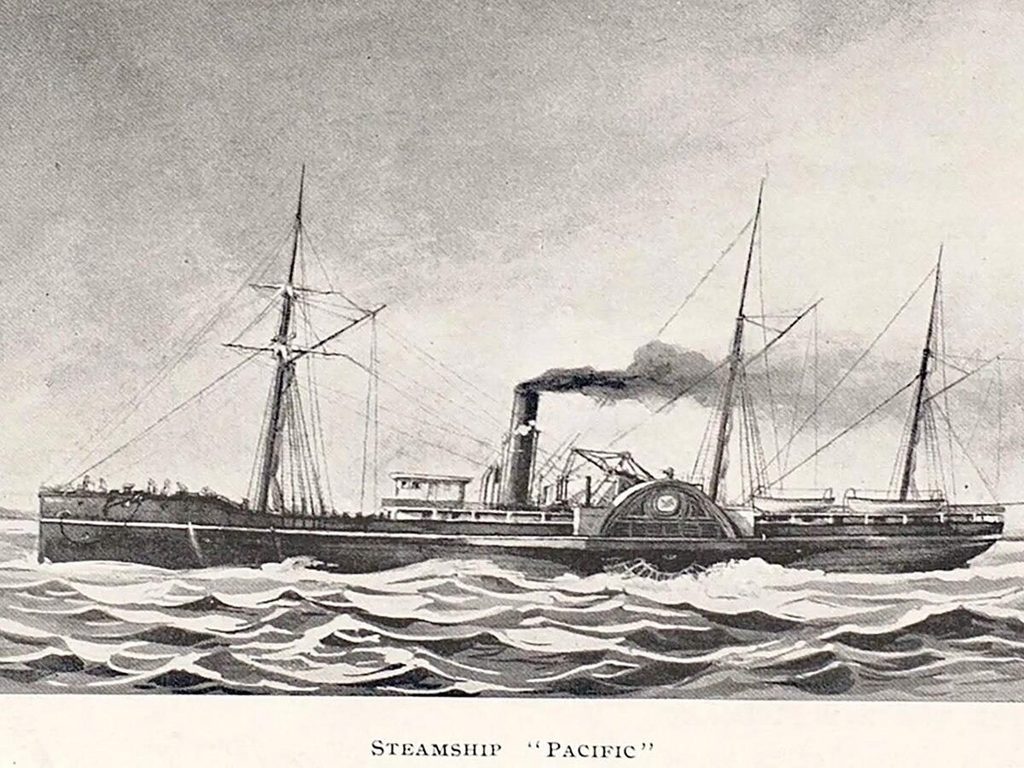
On November 4, 1875, the SS Pacific, a sidewheel steamship bound from Victoria, British Columbia, to San Francisco, sank off the coast of Washington following a collision with the sailing vessel Orpheus. The Pacific carried some 270 passengers and a cargo that included gold. It was one of the deadliest maritime disasters in Pacific Northwest history, and only two people aboard are known to have survived.
Kraft Davies Olsson represents the descendant of a wealthy passenger who perished in the disaster while traveling aboard the Pacific with a substantial quantity of gold. Our client filed a timely claim in the case asserting an interest in cargo aboard the vessel, through business entities connected to his ancestor, and an interest in recovering his ancestor’s remains and personal effects if they are ever located.
Rockfish, Inc., a Washington company formed in 2016 to find the Pacific, announced that it had located the wreck and filed an in rem action in November 2022. The court issued a warrant for the arrest of the vessel, appointed Rockfish as substitute custodian, granted it exclusive salvor rights, and required it to file a salvage plan and periodic status reports. In its amended complaint, Rockfish sought a salvage award, title under the law of finds, an injunction protecting its exclusive salvage rights, and a declaration that it owns the vessel by assignment from the successors of the Pacific’s original owner.
We were initially optimistic that Rockfish would successfully recover the gold belonging to our client’s ancestor and others who perished aboard the Pacific. A successful salvage would have brought the property within the court’s reach, and our client could then have asserted ownership subject to a fair salvage award.
The years that followed did not bear out that optimism. By November 2026, Rockfish reported that it had completed 20 expeditions to the site. Yet it acknowledged that it had recovered nothing beyond a firebrick and wood, both obtained before it filed the lawsuit. Although Rockfish reported in May 2026 that it had mapped more than 450 objects on the seafloor, it offered no explanation for why none had been recovered. Evidence developed during the litigation also raised serious questions as to whether Rockfish had located the wreck of the Pacific at all.
Our firm moved for summary judgment seeking dismissal of Rockfish’s claims to a salvage award and to ownership of the unrecovered cargo under the law of finds, and asking the court to dissolve the injunction. Rockfish filed its own motion seeking to dismiss our client’s claims to the cargo. On November 24, 2026, Judge James L. Robart granted our motion and denied Rockfish’s.
Salvage. The court held that Rockfish had not shown success in whole or in part. Recovering an isolated artifact may support a claim to that specific item, the court explained, but it does not establish partial success entitling a salvor to an award over separate, unrecovered cargo. The court also rejected Rockfish’s arguments that earlier orders in the case, including its settlement with the cargo insurers and the denial of an earlier motion to dismiss, relieved it of the obligation to prove success, and it declined Rockfish’s request to postpone the ruling so it could report on an October 2026 expedition after discovery had closed.
“Under settled admiralty law, locating, identifying, and exploring a sunken vessel—however diligently—does not constitute salvage success absent the actual recovery and preservation of imperiled property.”
Law of finds. The finds claim failed for the same reason. Having recovered nothing beyond a firebrick and wood, Rockfish could not show that it had reduced the vessel or its cargo to actual or constructive possession, much less that the property had been abandoned by its owners.
Exclusive salvage rights. Because Rockfish’s exclusive salvor status depended on its salvage claim, the court held that the dismissal of that claim removed the legal basis for the injunction, and it dissolved the injunction.
Rockfish’s motion against our client. Rockfish had argued that our client could not prove his ancestor owned any of the gold. The court denied the motion for three independent reasons: it was moot once Rockfish’s own claims were dismissed; Rockfish, with no remaining claim to the cargo, lacked standing to challenge our client’s ownership claims; and the court lacked in rem jurisdiction to decide competing ownership claims to unrecovered cargo resting on the seabed in international waters.
The salvage and finds claims were dismissed without prejudice to Rockfish reasserting them if it actually recovers and preserves property from the wreck site. The only claim left is Rockfish’s request for a declaration that, by assignment from the successors of the Pacific’s owner, it holds whatever rights that owner had in the vessel itself, which does not extend to the cargo. The court has ordered Rockfish to show cause by December 8, 2026 why that claim should not also be dismissed.
The court’s ruling opens the door for other salvors to search for the Pacific and renews the possibility that the shipwreck and its historic cargo may one day be recovered. When that happens, claims to the gold will be decided on their merits rather than through one company’s exclusive hold on the site.
We are proud to have achieved this result on behalf of our client and look forward to seeing what the next chapter holds in the remarkable story of the SS Pacific.
The Pacific case illustrates several principles that matter to anyone involved in a salvage dispute, whether as a salvor, a vessel owner, an insurer, or the heir of someone whose property was lost at sea.
Success is the price of a reward. No matter how much time and money a salvor invests, the law does not pay for searching, mapping, or exploring. Courts look at what was actually recovered and preserved.
Exclusive rights are conditional. An injunction protecting a salvor lasts only as long as the salvage claim behind it. Interested parties can ask the court to revisit it, and the court can dissolve it when the claim fails.
File on time. Our client was able to challenge Rockfish because he filed a statement of interest promptly after notice of the arrest was published. Claimants who did not file were defaulted.
Finding is not owning. Locating a wreck, or believing one has located it, does not transfer title. The law of finds requires possession and proof of abandonment, and courts favor salvage whenever owners or their successors come forward.
The hull is not the cargo. Even a party that acquires the rights of a vessel’s original owner does not thereby own the cargo and personal effects that passengers and shippers carried aboard.
Salvage is dangerous work. Divers, ROV operators, deckhands, and crane crews work in heavy weather, at depth, and around damaged vessels and unstable loads. When someone is hurt during a salvage operation, their rights depend on their role and the vessel they worked on. A crew member of a salvage vessel may be a seaman with claims under the Jones Act, for unseaworthiness, and for maintenance and cure. Other workers may be covered by the Longshore and Harbor Workers’ Compensation Act or by general maritime law. Our firm represents injured maritime workers and their families in these cases, as well as owners and claimants in salvage disputes.
Whether you are a vessel owner facing a salvage claim, a salvor seeking a fair award, or the descendant of someone whose property was lost at sea, Kraft Davies Olsson can help you understand your rights under admiralty law. Our attorneys practice maritime law from Seattle and handle cases throughout the Pacific Northwest. (206) 624-8844